
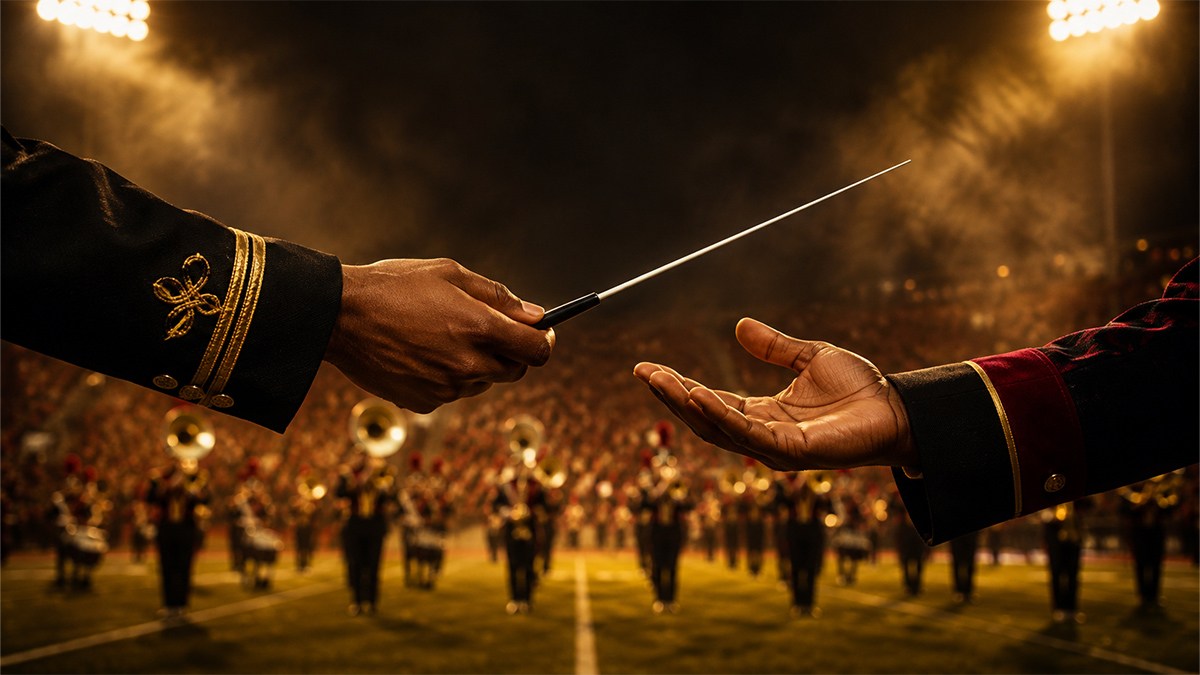
The 2026 season will bring new sounds, new leadership and some familiar faces to HBCU marching band programs across the country.
More than a dozen HBCU band programs have entered the year with newly assigned directors or interim leadership, creating significant movement at both the Division I and Division II levels. In many cases, the new directors are not strangers to HBCU band culture. They are alumni, former assistants or directors who have spent years developing their craft inside the tradition they will now be responsible for leading.
Familiar faces step into bigger HBCU band roles
Florida Memorial University turned to continuity, elevating Brian Snell after his time as an assistant at the university. Snell earned his undergraduate degree at Florida A&M, bringing another layer of HBCU band experience to his new assignment.
Virginia Union University also brought in someone with direct ties to the institution. Andrew Miles arrives after working at Huguenot High School in Richmond and is a Virginia Union graduate. Tuskegee University selected Dr. Warren Williams, formerly of Carver High School in Atlanta. Williams earned his undergraduate degree at Alabama State.
Allen University hired Jovan Milford, who previously worked at Claflin College and earned his undergraduate degree at Benedict College. Meanwhile, Edward Waters University selected Marques Graham after his time at Allen University. Graham is a South Carolina State graduate.
Those moves illustrate just how interconnected the HBCU band world remains. Directors frequently compete against programs led by former classmates, colleagues and mentors while continuing traditions they experienced themselves as students.
Arkansas Baptist University hired Cedric Todd, a former Southern University assistant who also earned his undergraduate degree at Southern. Texas College selected Thomas Williams Gibson after his time at Carter High School in Dallas. Gibson is also a Southern graduate.
Jarvis Christian University will be led by Michael Bradley, who previously worked at Ville Platte High School in Louisiana and attended Grambling State University.
Lane College turned to Charles Conner, formerly an assistant at Alabama A&M. Conner earned his undergraduate degree at Fayetteville State University.
Division I programs make major changes
The movement extends into several of the most recognizable HBCU band programs in Division I.
North Carolina A&T will enter the season with Aaron Campbell serving as interim director. Campbell was previously an assistant at A&T and is also a graduate of the university.
Mississippi Valley State University followed a similar path by promoting from within. Kevin Webb, previously an MVSU assistant and an alumnus of the university, takes over the program.
One of the biggest changes comes at Alabama State University, where Dr. Derrick Smith takes over after working at the University of Alabama. Smith earned his undergraduate degree at Alabama State, making his appointment a homecoming as he assumes leadership of his alma mater’s band program.
Alabama A&M University also has new leadership with William Young, who previously served as an assistant at Southern University. Young earned his undergraduate degree at Southern as well.
The 2026 changes come during a period when HBCU bands have become increasingly visible beyond football Saturdays. Battle of the bands events, nationally televised performances and viral social media moments have expanded the reach of programs that have long been among the most recognizable parts of HBCU culture.
That visibility also increases the responsibility placed on the people holding the baton.
A band director is tasked with protecting tradition while recruiting students, developing musicians, managing staffs and creating a product that can satisfy alumni who often have strong opinions about exactly how their band should look and sound.
For the newest group of HBCU band directors, the opportunity begins in 2026.
Some are returning home. Others are climbing the ladder after years as assistants. Several are bringing experience from high school programs into the college ranks.
But they all inherit the same challenge: taking an established HBCU tradition and figuring out where to lead it next.