
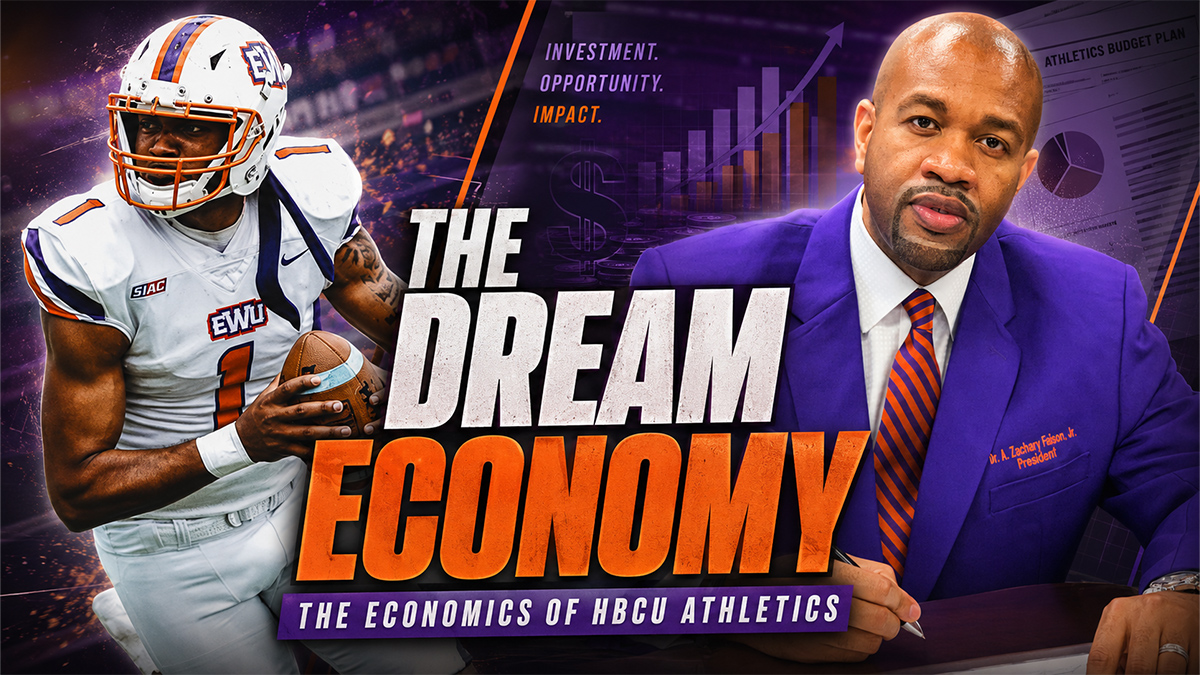
HBCU Presidents play a vital role in shaping the future of athletics at their institutions. A. Zachary Faison, Jr., Ed.D., J.D. of Edward Waters has submitted this editorial to HBCU Gameday.
In the final two minutes of the first round of the 2026 NCAA Division II Women’s Basketball Tournament, my university’s team stood on the floor of the University of Alabama Huntsville — trailing by two points. The crowd was loud. The moment was real. And the team wearing Edward Waters University across their chests earned every second of it.
UAH won that game and went on to reach the NCAA Division II Final Four. But before they did, they had to get past a women’s HBCU basketball program that had just finished with the best regular season record in the Southern Intercollegiate Athletic Conference and the Eastern Division Championship, from a 160-year-old HBCU in Jacksonville, Florida. A program built not on lavish athletic budgets, Power Four infrastructure, or multi-million-dollar coaching contracts, but on a fundamentally different financial model. One that most of higher education has never seriously considered.
This approach is especially critical for HBCUs.
I call it the ‘Dream Economy’. And I believe it is the most honest, sustainable, and mission-aligned athletics model available to the HBCU sector, and particularly for small private and public HBCUs and NAIA institutions operating in 2026.
The Wrong Model, Borrowed from the Wrong Institutions
Walk into almost any HBCU athletics department competing at the NCAA Division I, II, or NAIA level, and you will find, somewhere beneath the surface, an implicit aspiration toward the NCAA Power Four model. The language is the same. The organizational charts look similar. The conversations are about ticket sales, media deals, and donor cultivation — revenue streams that are largely theoretical at institutions of our size and scope.
Consider Penn State Athletics. In 2024–25, football alone generated tens of millions in operating surplus, enough to subsidize the overwhelming majority of the department’s remaining sports programs, many of which operated at significant deficits. That is the financial architecture of Power Four athletics: one or two revenue-producing sports underwriting everything else.
The majority of HBCUs at the NCAA Division I level, and especially those competing at the NCAA Division II and NAIA levels, lack that kind of concentrated economic engine. We never did. Yet too many of our athletics departments still operate as though television revenue, multi-million-dollar major donor pipelines, and large-scale ticket sales are just around the corner. The result is predictable: chronic deficits, institutional strain, and presidents forced to defend athletics as a financial liability rather than a strategic enrollment asset. But it doesn’t have to be this way. This doesn’t have to be the case for HBCUs.
The Dream Economy: What It Is and Why It Works
The Dream Economy begins with an honest acknowledgment of two facts that higher education administrators rarely say out loud.
This model is especially vital for the sustainability of HBCUs.
First: the overwhelming majority of student-athletes at our NCAA Division I, NCAA Division II, and NAIA institutions will not play professionally. That statistical reality is unambiguous. But that is not what drives their decision to compete. What drives it is the dream — the deeply held belief, cultivated from childhood, that collegiate athletic competition is both achievable and transformative. And that belief has genuine, measurable economic value that families are willing to invest in through higher education.
Second: at institutions like Edward Waters University, athletics revenue does not come primarily from ticket sales, media rights, or merchandise. It comes from student athletes who enroll, pay tuition, live in our residence halls, and eat in our dining facilities. The athlete is not merely a competitor. The athlete is also an enrolled student whose attendance generates net tuition revenue that supports institutional operations.
Once you internalize those two facts, the entire financial architecture of athletics changes.
In the Dream Economy, an athletic scholarship is not a budget line item — it is a student acquisition cost. I use that term deliberately, and I am aware of its corporate connotations. But the alternative, pretending that scholarship dollars are pure subsidy rather than a managed institutional investment, is precisely the analytical failure that has bankrupted dozens of small private colleges, including HBCUs, and forced the closure of campuses that served the very students our sector exists to serve. Naming the financial logic is the precondition for mission survival, not a betrayal of it. The recent history of small private higher education is a graveyard of institutions whose leaders refused to make this analytical move. Sweet Briar College nearly closed in 2015 and survived only through an extraordinary alumni intervention. Saint Joseph’s College in Indiana suspended operations in 2017. Among HBCUs, Saint Paul’s College closed in 2013, and Saint Augustine’s University in Raleigh has spent the last several years in an extended accreditation and financial crisis whose outcome remains uncertain. These were institutions with real missions, real constituencies, and real value to deliver — and they were lost, or nearly lost, in part because their leadership could not bring themselves to characterize tuition discounting, athletic scholarships, and enrollment-driven aid as the managed financial instruments they actually are. The institutions that survive in this sector are the ones that learn to name the investment economics out loud. The ones that refuse place themselves in existential jeopardy.
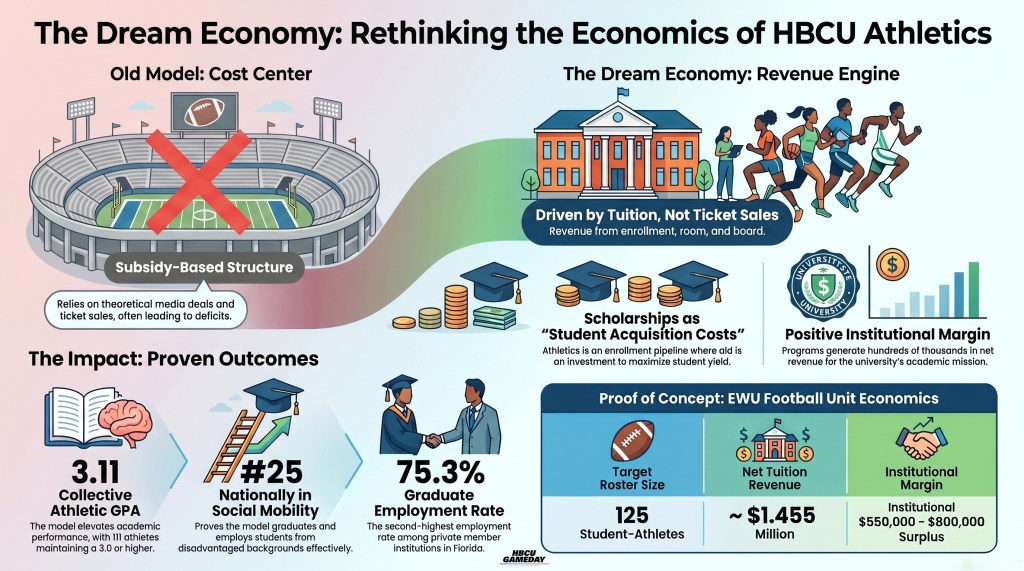
The return on that investment is calculated not by ticket revenue but by net tuition margin. A head football coach at EWU does not have a win-loss goal alone. He has an enrollment goal. My football program targets a roster of 125 student-athletes. We fund the equivalent of approximately 28 full scholarships against the NCAA Division II maximum equivalency limit of 36. The remaining 98 student-athletes enroll through a combination of Pell grants, state aid, institutional scholarships, and, in some cases, family contributions, while pursuing the opportunity to compete in legitimate NCAA Division II football competition — because they want to compete and play NCAA Division II football. That is the Dream Economy in operation.
To understand how this works in practice, consider the unit economics of Edward Waters football.
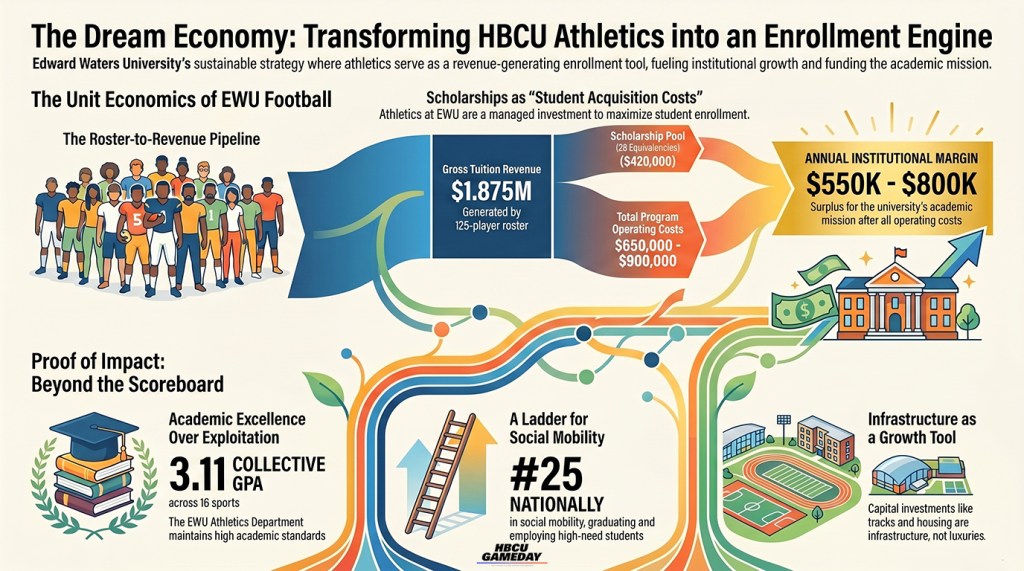
At the NCAA Division II level, football scholarships operate on an equivalency basis rather than as full grants-in-aid. The Division II maximum is 36 equivalencies. Our program is funded at 28 equivalencies, calculated against an institutional tuition cost of approximately $15,000 per student, which yields a head-coach-controlled scholarship pool of approximately $420,000 in tuition-discount authority. That pool is not distributed as 28 full awards. It is allocated by the head coach across a target roster of 125 student-athletes, the vast majority of whom receive partial awards. The remaining cost of attendance — room, board, and fees — is real institutional cost, not discountable aid, and is covered by each student-athlete through the same financing pathways available to every other EWU student: federal Pell grants, Florida EASE awards, federal and institutional work-study, family contribution, and, in a smaller number of cases, additional institutional aid.
The revenue side is straightforward. A 125-player roster at EWU, with published tuition of approximately $15,000, generates roughly $1.875 million in gross tuition revenue. Applying the $420,000 equivalency-based scholarship pool against that gross yields approximately $1.455 million in net tuition revenue at the program level, before accounting for any additional institutional discounting applied to individual students. The cost side is equally straightforward. A fully loaded Division II football program — coaching salaries, recruiting, equipment, travel, and operations — typically runs between $650,000 and $900,000 annually at our scale. EWU operates within that band. The result is a program that, under disciplined execution, generates a positive contribution to institutional margin of $550,000 to $800,000 annually in net tuition revenue after program costs, before considering the room and board contribution to auxiliary operations. A portion of that margin is strategically reinvested in the football program itself as competitive athletics require competitive investment, and a program that cannot recruit, travel, and compete at a legitimate Division II level cannot sustain the enrollment yield that produces the margin in the first place. The majority, however, flows directly to the institution’s academic mission.
This is the architecture. Football is not a cost center subsidized by the institution. Football is an enrollment instrument that generates net revenue for the institution. The scholarships are not an expense. They are a managed discount portfolio designed to maximize yield against a target roster size. And the head coach is not running a sports franchise. He is running a $1.4 million enrollment pipeline with athletic competition as its delivery mechanism.
Is This Exploitation From An HBCU? The Question You Are Already Asking
I anticipate the objection. If you are monetizing the athletic dreams of predominantly Black, predominantly first-generation students from lower-income families, are you simply not a more sophisticated version of the predatory for-profit college model that was rightly dismantled over the past decade?
The answer is no — and the distinction matters enormously. Because what is being offered to these students is not an illusion. It is opportunity, competition, structure, credentialing, and upward mobility with measurable outcomes. The predatory for-profit model extracted tuition in exchange for credentials of questionable value, with poor completion rates and graduates who could not find employment commensurate with their debt. The Dream Economy, properly executed, delivers three things that dismantle that comparison entirely.
First, a legitimate competitive athletic experience. In only our second full year of competition as a full NCAA Division II member, our Edward Waters University football team defeated the #13-ranked program in the country this past season. Our women’s basketball team finished the 2025-26 season with the best regular season record in the Southern Intercollegiate Athletic Conference (SIAC), won the Eastern Division Championship, made the program’s first NCAA Tournament appearance, and competed within two points of a Final Four program on the road with under two minutes to play in the opening round. This season, our baseball program captured the SIAC Baseball Championship—its second in the last three years—and will head out to the NCAA Tournament later this week. These are not participation trophies. This is genuine NCAA Division II competition at a high level, across multiple sports, produced by the same enrollment-driven model.
Second, an accredited degree with documented lifetime value. EWU’s regional accreditation was reaffirmed by SACSCOC in December 2025 with zero recommendations for improvement — the same regional accreditor that affirms institutions such as the University of Florida, Florida State University, and every major college or university in the Southeast. At approximately $25,000 annually for tuition, fees, room, and board, EWU remains one of the lowest-cost private four-year universities in Florida and the broader region. After Pell grants, Florida EASE awards, and work-study, the net cost for many of our students is substantially lower. And the return on that investment is not theoretical. The Georgetown University Center on Education and the Workforce puts median lifetime earnings for bachelor’s degree holders at $2.8 million — 75 percent more than workers with only a high school diploma. The degree still pays. The data on that point are not seriously in dispute.
Relatedly, there is a structural reality the critique tends to ignore. Every undergraduate program in American higher education sells a partially aspirational product. The pre-med major who will not become a physician, the theater major who will not reach Broadway, the political science major who will not hold elected office, the business major who will not run a Fortune 500 company — these students populate every college and university in the country, and no one accuses those institutions of exploitation. Athletics, in fact, is among the more transparent aspirational products in higher education. The odds of professional competition are widely published, openly discussed, and broadly understood by recruits and their families before they ever sign a National Letter of Intent. Pre-med students rarely receive the same statistical candor about medical school admission rates from the institutions recruiting them.
And there is a second reality the critique also tends to overlook. For a significant share of the student-athletes enrolling at institutions like Edward Waters University, the relevant alternative is not a “better” four-year option. The alternative is no four-year option at all. This access point is crucial for the HBCU mission. The exploitation framing presupposes that these students are being diverted from superior pathways. In most cases, they are not. They are being offered access to a pathway that would otherwise remain closed; accredited, competitive, credentialed, and structured through the one motivational vehicle that actually moves them.
At Edward Waters University specifically, the outcomes data further reinforce that distinction. According to 2024 graduate employment data compiled by Independent Colleges and Universities of Florida (ICUF)—the statewide association representing 30 private, nonprofit colleges and universities across Florida—EWU graduates posted the highest graduate employment rate among private institutions in Jacksonville and the second-highest employment rate among all ICUF member institutions statewide at 75.3 percent. EWU graduates also reported median annual earnings higher than both of Florida’s other private HBCUs. This is the proof point. The Dream Economy is not a system that uses athletes and discards them; it is a system that graduates them, employs them, and moves them up the economic ladder. In 2025, U.S. News and World Report ranked EWU #25 nationally in social mobility, which measures how effectively colleges and universities enroll and graduate students from disadvantaged and lower-income backgrounds. These are not the outcomes of students being exploited. They are the outcomes of students obtaining accredited degrees with measurable labor-market value.
Third, and perhaps most telling: the numbers speak for themselves. In Fall 2025, the Edward Waters University Athletics Department posted a collective GPA of 3.11 across 16 sports. One hundred and eleven student athletes carried above 3.0. Twenty-six carried a perfect 4.0. Six teams posted a GPA above 3.25. Our softball program — the highest women’s team — posted a 3.58. Our men’s volleyball program posted a 3.28. These are not the academic outcomes of students’ exploitation. On the contrary, these are the results produced by students who chose EWU, compete at a high level, and perform in the classroom at a rate that outpaces our general student body. The Dream Economy does not depress academic outcomes. At EWU, it elevates them. In fact, for many of our students, particularly first-generation students from historically under-resourced communities, athletics is not a distraction from higher education. It is the access point into it.
Rethinking the Gender Equity Debate at Our Level
The conventional Title IX compliance conversation at small institutions is almost entirely framed around the Power Four cross-subsidy model — how do we use football revenue to fund women’s sports? But in the Dream Economy, that framing dissolves.
Every sport at EWU is evaluated by the same metric: does the program generate net enrollment revenue that exceeds its fully loaded program cost? Women’s volleyball, women’s basketball, and softball — each of these programs recruits a roster, converts athletes to enrolled students, and produces tuition revenue. The question is not whether women’s volleyball generates ticket sales. The question is whether the women’s volleyball roster generates net tuition margin.
When you reframe the analysis this way, Title IX compliance stops being an expense and becomes an enrollment strategy. You are not cross-subsidizing women’s sports out of football surplus, you are instead running parallel enrollment pipelines, each evaluated on the same institutional ROI standard. The model is gender-neutral by design and financially coherent by necessity.
The Living Learning Center and the Infrastructure Argument
EWU is set to close later this summer on a $25 million transaction to fund construction of a new student residence facility and its first on-campus track. I want to be direct about why.
In the Dream Economy, capital investment in athletic and residential infrastructure is not a luxury — it is enrollment infrastructure for HBCUs. A recruit choosing between EWU and a competitor offering similar scholarship dollars will be influenced by the quality of the facility, the residential experience, and the sense that the institution is invested in their development. The track is not just a track. It is a recruiting tool, a retention asset, and a community engagement platform. The Living Learning Center is not just housing. It is the product that justifies the price point.
Small HBCU and NAIA presidents who defer capital investment in athletics infrastructure on the grounds that their sports do not generate revenue are making a category error. In the Dream Economy, the infrastructure does not follow the revenue. The infrastructure generates enrollment, which generates revenue.
The Risks You Need to Manage
The Dream Economy is not without risk. Two deserve direct attention.
The first is the NIL and transfer portal landscape. As name, image, and likeness opportunities and expanded scholarship competition concentrate athletic talent upward, even at the HBCU Division II level, the supply of enrollable, dream-motivated recruits willing to enroll without or with only partial athletics aid will face increasing competition. Presidents running the Dream Economy need coaches who are exceptional at identifying recruits for whom EWU’s combination of competitive experience, credential value, and price point represents a genuine best option. That is a different recruiting skill set than simply signing the most talented athletes available.
The second is the six-year graduation rate. The transfer portal suppresses six-year graduation rates at programs like ours — not because our athletes are failing academically, but because they transfer upward to Division I programs. In many cases, those upward transfers reflect that institutions like EWU successfully identified, developed, and elevated student-athletes who became competitive at the Division I level, which is itself a validation of the developmental product we deliver. But it requires presidents to be proactive in contextualizing graduation data for accreditors, rankings systems, and public audiences who do not yet have the analytical framework to interpret it correctly.
A Call to Our Peers
To my colleagues leading HBCUs and especially those of us at the helm of NCAA Division II and NAIA institutions: the Penn State model is not your model. It was never your model. The sooner you stop measuring your athletics program against a financial architecture that requires a $57 million football surplus to function, the sooner you can build something that works for your institution.
The Dream Economy is not a compromise. It is not a consolation prize for HBCU institutions that cannot afford the real thing. It is a financially coherent, mission-aligned, outcomes-validated model that meets students where their deepest motivations actually live — and delivers genuine value in exchange. Every 13-to-18-year-old in America with athletic ability dreams of competing at the next level. That dream is real, powerful, and economically significant. The question is not whether to engage it. The question is whether you are prepared to deliver a product worthy of it.
At Edward Waters University, on a Tuesday night in March in Huntsville, Alabama, with two minutes left and two points down against a team that would reach the national Final Four — we were.
A. Zachary Faison, Jr., Ed.D., J.D., is the longest-tenured HBCU president in the State of Florida and serves as President & Chief Executive Officer of Edward Waters University, the State of Florida’s first private independent institution of higher learning and first historically black college or university, founded in 1866. He holds an Ed.D. from Vanderbilt University Peabody College, a J.D. from the University of Georgia School of Law, and he is a member of the State Bar of Georgia.
Great article.