
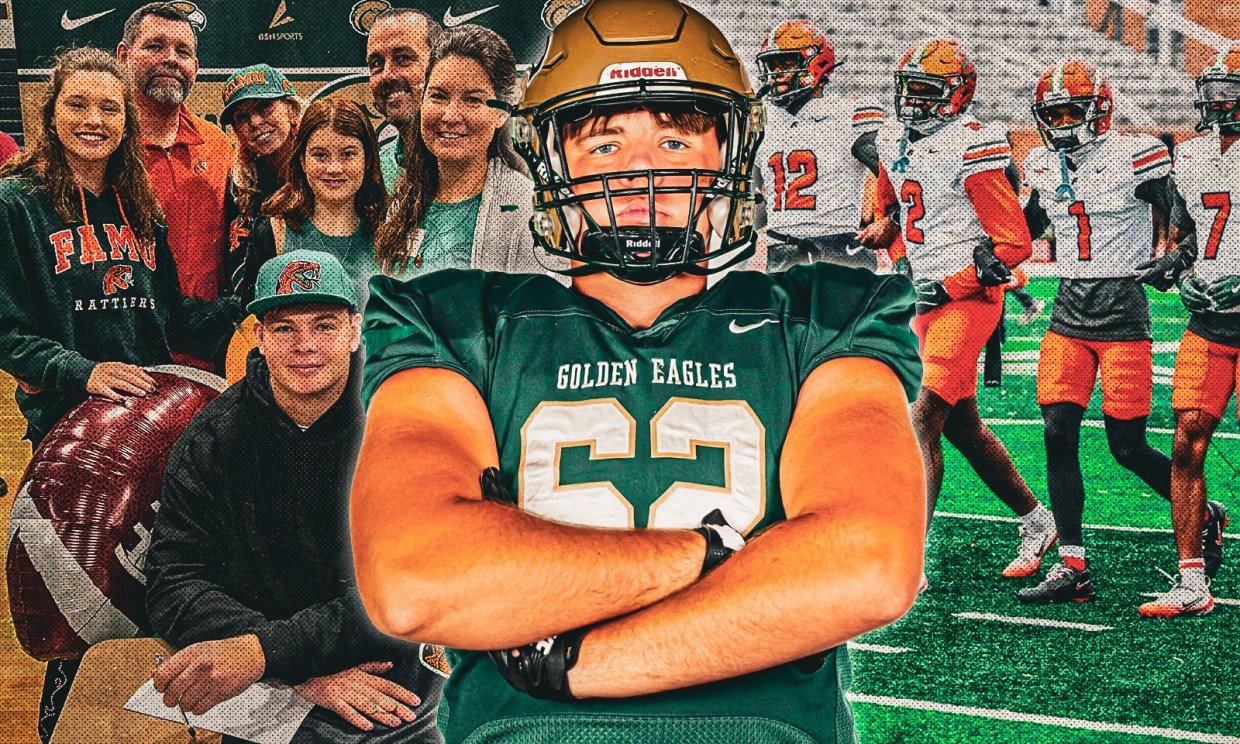
National Signing Day always produces its share of graphics, hats, and ceremonial pen strokes. But every once in a while, a single image cuts through the noise and tells a story bigger than football. That’s what happened when a photo of offensive lineman Corbett Yarbrough, flanked by his family at his signing ceremony, began circulating across social media after he committed to play HBCU football at Florida A&M University (FAMU).
At first glance, the reason it traveled was obvious. Yarbrough is white. FAMU is one of the most prominent Historically Black Colleges and Universities in the country. That contrast — still uncommon enough to register — became the punchline for a wave of playful internet commentary.
“Jit left as Corbett but gone come back ‘C-Money.’” “Corbinthius loading…”“FAMU bout to put that confidence on him.”
The jokes weren’t hostile. They weren’t mean-spirited. They were familiar — the kind of banter rooted in shared cultural awareness between Black and White Americans who understand how HBCUs are perceived: places that don’t just educate or train athletes, but shape people.
And while the internet laughed, something more interesting was happening beneath the surface.
Because this wasn’t just a viral photo. It was a quiet statement about where HBCU football stands in 2026.
A Power Four Legacy Chooses an HBCU Path
What many casual observers missed is the deeper layer of the story: Corbett Yarbrough is not just any recruit.
He’s the son of Corbett “Corey” Yarbrough Sr., a former University of Florida football letterwinner from 1995 to 1999 and a member of the 1996 Gators national championship team — a roster etched into SEC and college football history.
That context matters.
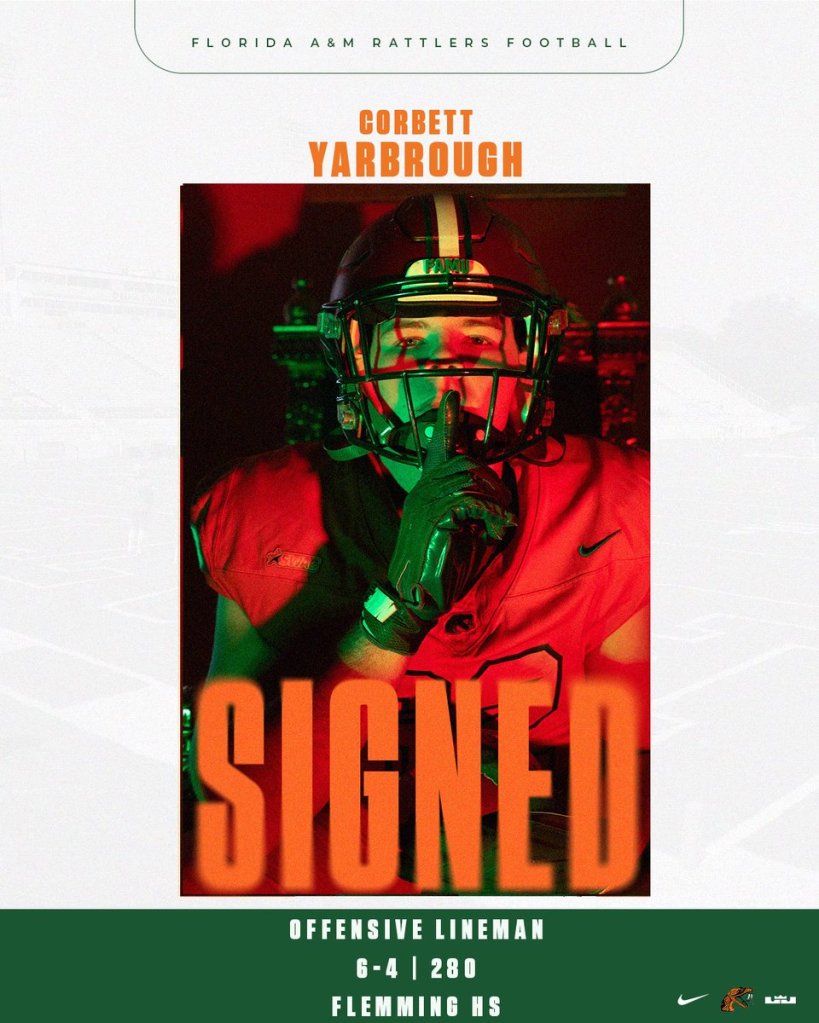
This isn’t a player choosing an HBCU because of limited options. Corbett Yarbrough held offers from Georgia Southern, Arkansas State, and Army, among others. Instead, he chose FAMU — one of HBCU football’s biggest brands — as a true freshman offensive lineman in head coach Quinn Gray’s rebuilding push.
That decision represents something college football is still adjusting to: an HBCU no longer framed as a backup plan, but as a destination.
For a Power Four national champion and his family to openly, proudly send their son to an HBCU says more than any marketing campaign ever could. It speaks to trust. To respect. And to the credibility programs like FAMU have built on and off the field.
The Racial Component — Without the Performative Pause
It would be dishonest to ignore race here. The reaction to the photo happened because of race. But what made it resonate is how that racial moment played out.
There was no outrage cycle. No think-piece pile-on. No forced symbolism.
Instead, there was humor — the kind that only works when people recognize shared cultural truths. The jokes weren’t about exclusion. They were about inclusion. About confidence. About what it means to spend four years immersed in a space that carries its own rhythm, style, and pride.
HBCUs have always been places where identity is sharpened, not erased. That doesn’t change based on skin color.
And for decades, white athletes who entered those spaces learned quickly what HBCU communities already knew: if you show up respectful, committed, and willing to work, you’re family.
White athletes at HBCUs are not a modern phenomenon. They’ve been part of the fabric for generations — often quietly, sometimes prominently.
Not the First — Just the Most Recent
At FAMU, no example looms larger than Ryan Stanley.
From 2016 to 2019, Stanley didn’t just play quarterback for the Rattlers — he rewrote the record books. He left FAMU as the program’s all-time leader in passing yards, touchdowns, completions, and attempts. He earned MEAC Offensive Player of the Year, became a finalist for the Black College Football Player of the Year award, and led FAMU to a 9-2 season that culminated in an HBCU national championship designation.
Along the way, Stanley picked up a nickname that said as much about culture as it did about football: “Sunshine.”
In football circles, the name is a familiar one — a nod to Remember the Titans and the character Ronnie “Sunshine” Bass, the long-haired white quarterback who finds his place and voice on a newly integrated team. The reference isn’t accidental. Like the movie character, Stanley arrived at an HBCU as an outsider on paper, then earned his standing through performance, leadership, and authenticity.
At FAMU, “Sunshine” wasn’t a novelty label. It was a term of respect — shorthand for a quarterback teammates trusted, fans embraced, and a program rallied behind. The nickname stuck not because Stanley was different, but because he fit.
Part of the Fabric, Not the Footnote
That same pattern has repeated itself across HBCU football history. Jim Gregory, Grambling State’s first white quarterback under Eddie Robinson in the 1960s. His story was so significant that it inspired the 1981 TV movie Grambling’s White Tiger.
At FAMU, Stanley followed in the footsteps of Ben Dougherty, a transfer quarterback from Iowa State who led the Rattlers in the early 2000s and earned a reputation for his strong arm and toughness, becoming a fan favorite during his tenure in Tallahassee.
Bowie State wide receiver Rickie Simmons stood out in the 1970s as the program’s lone white player, leading the Bulldogs in receptions and eventually earning the trust of his teammates to the point that he was voted co-captain. At Langston University, quarterback Ross Smith became a recognizable figure in the early 2000s, known as the “White Lion” for his play and leadership within the program.
And more recently, Derrick Ponder served as the starting quarterback at Jackson State during the 2019 season, continuing a quiet lineage of white signal-callers who have earned their place at some of the most tradition-rich HBCU programs in the country.
The throughline has always been the same: HBCUs don’t gatekeep culture — they invite participation.
Why This Moment Matters — Quietly
Corbett Yarbrough hasn’t played a snap yet. His story at FAMU is still unwritten. But the reaction to his signing photo — and the context behind it — reflects something important about where college football, and HBCUs specifically, are right now.
This isn’t about proving inclusivity. It’s about demonstrating relevance.
An HBCU landing a Power Four legacy lineman isn’t a stunt. It’s a signal. A reminder that these programs are no longer fighting to be seen — they’re being chosen.
The viral photo made people laugh. The backstory makes people think.
And together, they tell a modern HBCU story — not wrapped in nostalgia or symbolism, but rooted in respect, opportunity, and the evolving reality of college football.
Sometimes progress doesn’t announce itself.
Sometimes it just signs the paper, takes the photo, and gets to work.
WHY did he choose FAMU? I didn’t get that from the article. Not that it matters. I’m just curious.